Two years ago my nightstand was a graveyard of half-used supplement bottles and a smartwatch app quietly judging my average of five-and-a-half hours a night. My doctor's exact words were something like "your cortisol looks like you're running from a bear" — not exactly a compliment. So I did what any spreadsheet-brained ops manager would do: I stopped reading the marketing copy on the bottles and started reading the ingredient panels instead, and then the actual studies behind those panels — because it turns out those are frequently not the same thing.
This page is the reference sheet that came out of that project. Every ingredient below is one I've taken, tracked, or dug into deeply enough that I could explain it to my team without notes. I also went back through every citation on this page and reread the paper each one is supposed to point to — not the summary on a supplement company's landing page, the actual paper — because I'd rather tell you "this one's thin evidence" than dress up a shrug as a breakthrough. A few of the sources that used to sit on this page turned out to point to research on completely different topics; one "source" for a sleep ingredient was, no exaggeration, a genetics paper about Italian chicken breeds. That's fixed now. I'd rather admit that happened than quietly swap in something else and pretend it didn't.
One more thing before the list: the $28 "NightShift Max" gummies I tried early in this whole experiment did nothing except leave a fruit-punch aftertaste and a mild feeling of having wasted $28. Keep that kind of result in mind any time a bottle promises the moon. Most of what actually holds up below behaves like a decent process fix at work — a small, compounding improvement, not a single lever that fixes everything overnight.
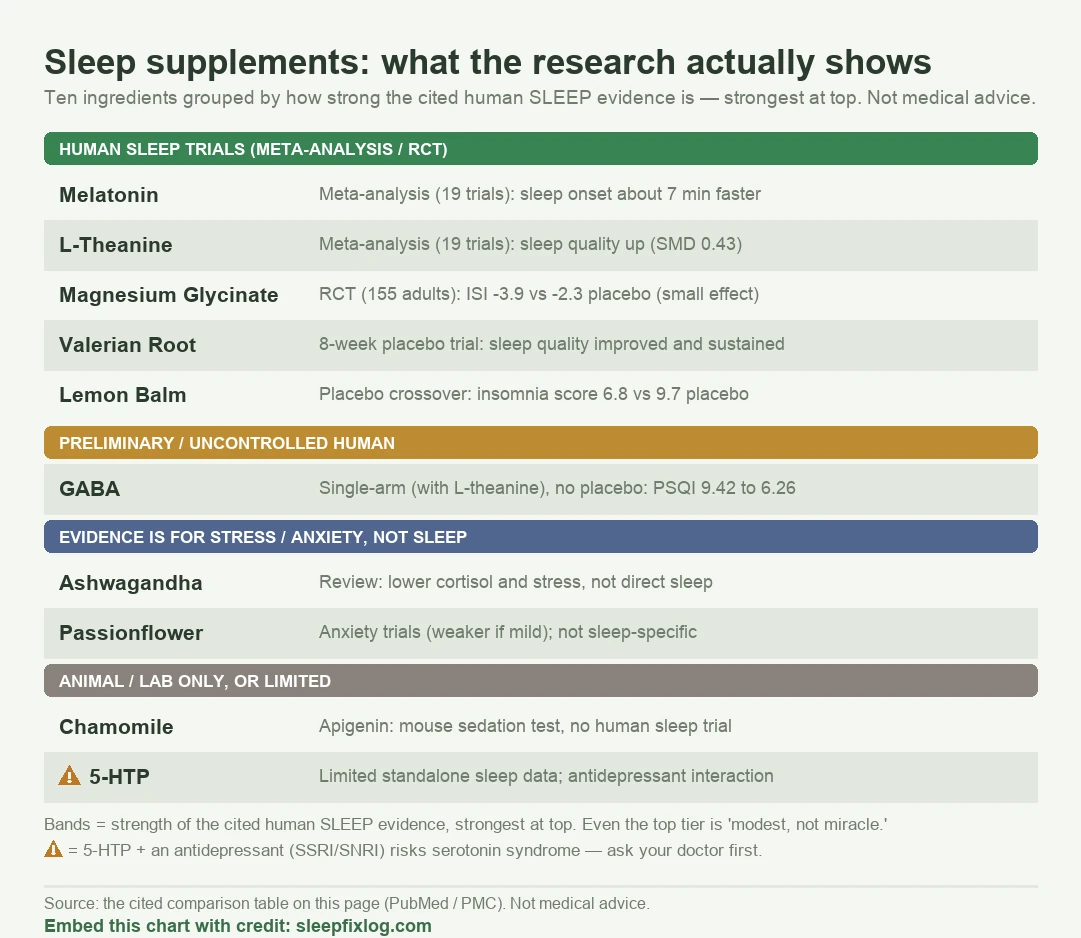
The honest sleep-aisle read: only five of these ten have real human sleep-trial evidence — meta-analyses or randomized trials for melatonin, L-theanine, magnesium, valerian, and lemon balm — and even the best of them is "modest, not miracle" (pooled data puts melatonin at roughly 7 minutes of faster sleep onset). Chamomile's sleep evidence is mouse studies; ashwagandha's is about stress, not sleep. And 5-HTP with an antidepressant is a real serotonin-syndrome risk, not an internet myth.
Natural Sleep Supplement Ingredient Comparison
Here's the quick-reference version — ten ingredients side by side, what each one is supposed to do, and what the actual research (not the bottle) says about whether it works.
| Ingredient | Classification | Primary Biological Mechanism | Clinical Evidence | Common Source/Form |
|---|---|---|---|---|
| Melatonin | Hormone / Indoleamine | Binds MT1 and MT2 melatonin receptors, thought to drive its effect on circadian timing and sleep onset (1). | Meta-analysis of 19 placebo-controlled trials (1683 subjects): sleep-onset latency down 7.06 minutes on average (95% CI 4.37–9.75) (2). | Synthetic (most common), or naturally derived from plants and some fermentation processes. |
| Magnesium (Glycinate) | Mineral / Amino Acid Chelate | Proposed to reduce NMDA receptor activity and stimulate GABA release, rather than bind GABA receptors directly (3). | 2025 RCT, 155 adults, 250 mg/day for 4 weeks: Insomnia Severity Index score fell 3.9 points vs 2.3 for placebo (p = 0.049, Cohen's d = 0.2) (4). | Elemental magnesium bound to glycine. |
| Valerian Root | Botanical / Perennial Herb | Valerenic acid's leading proposed mechanism is modulating GABA-A receptors (5). | 8-week placebo-controlled trial (35 placebo vs 37 valerian completers): sleep-quality scores improved significantly by day 14, sustained through days 28 and 56 (6). | Valeriana officinalis (root/rhizome). |
| L-Theanine | Amino Acid | Crosses the blood-brain barrier and is associated with a calmer, "relaxed alertness" state without direct sedation. | 2025 meta-analysis, 19 trials (897 participants): overall sleep-quality score improved (SMD 0.43, 95% CI 0.04–0.83) (7). | Camellia sinensis (tea leaves). |
| 5-HTP | Amino Acid Derivative | Decarboxylated into serotonin (5-HT), which is then converted into melatonin (8). | Interacts with serotonergic medications (see disclaimer below); limited standalone human sleep-outcome data. | Griffonia simplicifolia (seeds). |
| GABA | Neurotransmitter | The brain's primary inhibitory neurotransmitter; proposed to increase CNS inhibition and facilitate sleep (9). | Small single-arm study, no placebo (19 people), GABA 700 mg + L-theanine 200 mg/day for 4 weeks: PSQI score dropped from 9.42 to 6.26 (95% CI for the change −4.01 to −2.31, p<0.001) (10). | Fermented (e.g., Lactobacillus hilgardii). |
| Ashwagandha | Botanical / Adaptogen | May decrease hypothalamic-pituitary-adrenal (HPA) axis activity, lowering the cortisol response to stress (11). | Narrative review of multiple RCTs and animal studies links use to lower morning cortisol and reduced stress-scale scores; effect sizes vary widely by study. | Withania somnifera (root extract). |
| Chamomile | Botanical / Flavonoid | Apigenin binds benzodiazepine receptors in the brain (12). | Receptor-binding and sedation evidence comes from mouse locomotor testing against a diazepam control, not human sleep trials. | Matricaria chamomilla (flower). |
| Lemon Balm | Botanical / Lamiaceae | Rosmarinic acid is proposed to act on GABA-transaminase (GABA-T), the enzyme that breaks GABA down (13). | 2024 double-blind, placebo-controlled crossover trial: insomnia-severity scores fell to 6.8 vs 9.7 on placebo (p = 0.003); slow-wave sleep time up about 15%, REM down about 10%. | Melissa officinalis (leaves). |
| Passionflower | Botanical / Vine | In vitro, blocks GABA reuptake into brain-tissue synaptosomes; does not affect GABA release or breakdown (14). | Systematic review of nine clinical trials (participants 18+, treatment periods of one day up to 30 days): most found reduced anxiety, weaker in people with only mild symptoms; no adverse effects like memory loss reported. | Passiflora incarnata (aerial parts). |
Detailed Ingredient Profiles
- Melatonin
- Melatonin's the one everybody starts with — including me, back when I still thought sleep problems could be solved with a pill and stubbornness. It's a hormone, not a sedative, and it works less like flipping a light switch and more like nudging your body's clock a few minutes in the right direction. The pooled research puts the average benefit at a modest handful of minutes of faster sleep onset — real, but nowhere near the knockout effect the bottle's marketing implies. I still keep a low-dose bottle around for travel; I don't expect it to do much more than that anymore.
- Magnesium Glycinate
- This is the one that actually moved the needle for me, though not dramatically. A few weeks in, my wake-up-feeling-wrecked mornings got less frequent — not gone, just less frequent, which is basically how every real improvement at my job has ever gone too: incremental and a little boring. The trial data backs up "modest": a real but small improvement over placebo, not a miracle fix, and it seemed to matter more for people who weren't getting much magnesium from food to begin with.
- Valerian Root
- Valerian is the one that smells like a gym sock left in a car overnight — I will die on this hill. It's also one of the more consistently studied "natural" sleep aids, with a placebo-controlled trial showing steady improvement in sleep-quality scores that kept building the longer people stayed on it, rather than fading out. I didn't love the smell enough to stick with it past one bottle, which says more about my tolerance for foot odor than about whether it works.
- L-Theanine
- L-theanine's my go-to when I need to wind down without feeling drugged the next morning — the tea-derived amino acid that made green tea drinkers calm instead of just caffeinated. A recent review pooling numerous trials found a real, if modest, bump in overall sleep quality, and unlike some things on this list, it hasn't come with next-day grogginess in my experience. I'll take "modest but real" over "huge claims, no data" every time.
- 5-Hydroxytryptophan (5-HTP)
- 5-HTP is the one ingredient here I'd genuinely pump the brakes on. It sits one step away from becoming serotonin in your body, and combining it with a common antidepressant is a real interaction risk, not an internet myth. I haven't run a personal trial on this one — I mention it because it shows up on ingredient panels constantly, and "shows up a lot" isn't the same as "safe to combine with whatever else you're taking." If you're on any antidepressant, this is a talk-to-your-doctor-first ingredient, full stop.
- Gamma-Aminobutyric Acid (GABA)
- GABA's a strange one to take as a supplement, since your brain already runs on it — it's the main "quiet down" signal upstairs, and there's real debate over how much an oral dose even reaches where it needs to go. The one human sleep study I found pairing it with L-theanine showed a solid improvement in sleep-quality scores, but it wasn't placebo-controlled, so file that under "promising, not proven" rather than a verdict. I haven't personally run this one long enough to have an opinion worth sharing.
- Ashwagandha
- Ashwagandha's the one my wife actually stole off my shelf, which either says something about its usefulness or about her stress levels during tax season — possibly both. The general idea is that it takes some of the edge off your stress-hormone response, which matters for sleep because a wound-up nervous system doesn't wind down just because it's dark outside. The research base here is bigger and more consistent than for most things on this list, which is probably why it's stuck around in my rotation the longest.
- Apigenin (Chamomile Extract)
- Chamomile tea before bed is such an old cliché that I almost skipped researching it, assuming it was folklore with good marketing. Turns out one of its compounds does bind the same brain receptors targeted by anti-anxiety medications — though that finding comes from mouse studies, not humans drinking tea, so I'd hold the "ancient wisdom, vindicated by science" narrative loosely. I drink it anyway. It's pleasant, it's part of my wind-down routine, and even if the effect is mostly ritual, the ritual itself seems to help.
- Lemon Balm
- Lemon balm's the dark horse on this list — mild, minty, and backed by an actual placebo-controlled human trial that found meaningfully better sleep-quality scores than the placebo group got. It's not a knockout, but it's better evidence than half the flashier ingredients that get louder marketing. I added it to my rotation after reading the trial data, not before — which is exactly backwards from how I used to buy supplements.
- Passionflower
- Passionflower's more anxiety herb than sleep herb, technically, but the two overlap enough late at night that I'm including it. A review pulling together multiple human trials found it reduced anxiety in most of them, working less well for people whose anxiety was only mild to begin with — and nobody reported memory problems or other red flags. I haven't tracked a personal trial with this one specifically, but it's on my list to try next, mostly because the safety data looks clean.
Quick disclaimer, in my own words, because the legal boilerplate never actually helps anyone: everything above is what I've learned from my own sleep tracking and from reading the actual research, not medical advice from a doctor, because I'm not one — just a guy with a smartwatch and a chronic ops-manager need to quantify things. If you're pregnant, nursing, on prescription medication, or dealing with a sleep problem that's stuck around for more than a few weeks, talk to your actual doctor before adding any of this to your routine — especially 5-HTP if you're on an SSRI, SNRI, or other antidepressant, since that combination carries a real risk of serotonin syndrome, not a hypothetical one. Stacking multiple sedating ingredients (valerian, GABA, and high-dose magnesium together, say) can also compound drowsiness more than any single one would on its own. None of this replaces an actual conversation with someone who has your full medical history, which is not me.
Last verified: 2026-07-12
Sources
- (1) PubMed: The Efficacy of Melatonergic Receptor Agonists Used in Clinical Practice in Insomnia Treatment
- (2) PubMed: Meta-analysis: melatonin for the treatment of primary sleep disorders
- (3) PubMed: Magnesium in neuroses and neuroticism
- (4) PubMed: Magnesium Bisglycinate Supplementation in Healthy Adults Reporting Poor Sleep: A Randomized, Placebo-Controlled Trial
- (5) PubMed: A Review Focused on Molecular Mechanisms of Anxiolytic Effect of Valeriana officinalis L.
- (6) PubMed: Standardized Extract of Valeriana officinalis Improves Overall Sleep Quality in Human Subjects with Sleep Complaints
- (7) PubMed: The effects of L-theanine consumption on sleep outcomes: A systematic review and meta-analysis
- (8) PubMed: 5-Hydroxytryptophan (5-HTP): Natural Occurrence, Analysis, Biosynthesis, Biotechnology, Physiology and Toxicology
- (9) PubMed: Nutritional modulators of sleep: A narrative review of vitamins, minerals, amino acids, and their neurobiological and chronoepigenetic mechanisms
- (10) PubMed: Effects of combined GABA and L-theanine supplementation on sleep quality: an exploratory study
- (11) PubMed Central (PMC): Ashwagandha (Withania somnifera) and Its Effects on Well-Being
- (12) PubMed Central (PMC): A Comprehensive Study of Therapeutic Applications of Chamomile
- (13) PubMed: Effects of Melissa officinalis Phytosome on Sleep Quality
- (14) PubMed Central (PMC): Effect of Passiflora incarnata L. on Sleep and Anxiety