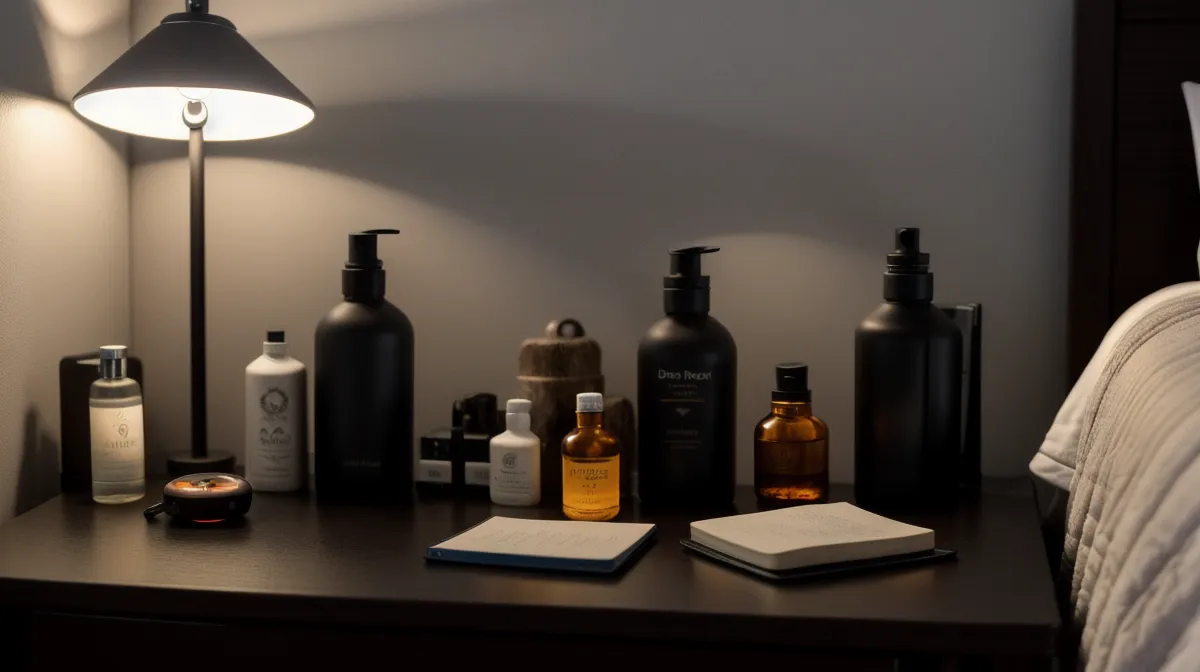
My wife is asleep within minutes of her head hitting the pillow — no tossing, no readjusting, just gone. I was lying there with my calves buzzing like they were still under load, hours past a brutal garage squat session, running the same loop in my head that used to run through my old department's year-end budget reviews: numbers that wouldn't close. That contrast is basically the whole reason I started testing tart cherry extract for exercise recovery and sleep in the first place — her baseline and mine were not even playing the same sport.
Before any of that: this site runs on affiliate links, and if you buy through one I earn a commission at no extra cost to you (the full transparency policy is linked elsewhere on the site, for anyone who wants the fine print). I only talk about sleep supplements I've actually put through my own nightly tracking. If post-leg-day restlessness sounds familiar, checking out YU SLEEP on their official site is the place I'd point you first.
Fifteen Years of Bragging About Running on Four Hours
For about fifteen years at my old operations job in suburban Atlanta, sleep sat on my mental spreadsheet as a discretionary expense — the kind of line item you cut first when things get busy. I was the guy in morning meetings who wore exhaustion like a badge, dropping into standup bragging about four hours of sleep like it made me tougher. That ended the day my annual checkup came back ugly: blood pressure sitting well past the clinical cutoff everyone quotes, and a doctor who told me flatly that my cortisol numbers looked like someone being chased by a bear, every single day.
None of this makes me any kind of expert — I'm not a doctor, not a sleep researcher, just an operations guy who processes everything through systems and error rates. So when my doctor told me to deal with the stress, I treated it like a project with a deadline. A garage gym went in, and four days a week of heavy compound lifts became the plan for burning off whatever my job had loaded onto me that day.
Lifting did clear my head during the day — that part worked immediately. But by early spring I'd run into a problem nobody warned me about: hard training doesn't knock you out at night, it keeps your nervous system humming. That soreness lifters call DOMS doesn't show up right away either; it creeps in a day or so later and sits in your legs right when you're trying to fall asleep. My resting heart rate stayed elevated, my legs wouldn't settle under the sheets, and I was stacking what I can only call sleep debt the same way a project stacks technical debt — you don't fix a chronic deficit by sprinting for one good night.

Why Tart Cherry Extract Became My Pick Over Synthetic Options
Stretching and foam rolling barely registered. Synthetic sedatives were off the table for me too, because waking up with a drug hangover ahead of a 9 AM quarterly review is its own kind of disaster. That search eventually pointed me toward Prunus cerasus, better known as Montmorency tart cherry.
Tart cherries carry natural plant compounds that are supposed to help with post-exercise soreness, along with a trace amount of melatonin that occurs naturally in the fruit — nowhere close to what's packed into a synthetic pill. I never went deep into the biochemistry of it, that's not my lane, but the food-based angle appealed to the part of me that distrusts anything marketed as an instant fix. I'd actually tried standard melatonin gummies earlier that year, the kind sold at any grocery store, and they did nothing for the soreness-driven waking — I'd still be up at 3 AM and foggy clear through to noon the next day, so synthetic melatonin was already off my list before cherry extract ever came up. For a broader rundown on what's actually inside these formulas, I wrote separately about natural ingredients in the best sleep supplements for staying asleep — worth a read whether you're the type who falls asleep fine but can't stay there, like me on heavy training nights, or someone who struggles to fall asleep in the first place.
Capsules Versus Liquid Concentrate: A Tradeoff I Learned the Hard Way
Shopping around turned up an obvious split in the market — concentrated liquid juice versus standardized capsules. Capsules weren't my first stop; a generic bottle of tart cherry juice concentrate from the grocery store was. Drinking a full glass of it an hour before bed created two problems fast: more trips to the bathroom overnight, and heartburn that made lying flat uncomfortable.
That one experiment taught me something most fitness blogs skip over. A liquid shot seems to act faster, but getting a precise dose out of a liquid is guesswork, and acidic juice right before lying down is asking for reflux. Capsules take longer to catch up, so you have to plan the timing earlier in the evening, but you know exactly what you're getting without the bathroom-trip tax. I settled on capsules for good after that and never looked back at the juice aisle.
Testing Three Formulations Through a Full Training Block
From late winter through early autumn 2026, I ran three different tart cherry formulations through my heaviest training days, tracking soreness, how many times I woke up, and my morning mental clarity in a notebook I keep on my nightstand next to the USB cradle for my smartwatch. By week ten of putting this through consistent heavy squat and deadlift blocks, stringing together decent recoveries back-to-back had stopped being the exception and started being what I expected — which, for someone who used to treat four hours of sleep as a personality trait, felt like a genuinely new baseline.
YU SLEEP: The One That Actually Calmed My Legs Down
YU SLEEP went into rotation during a high-volume squat block in early spring. What drew me to it was that it pairs tart cherry with other calming botanicals instead of leaning on synthetic melatonin — in operations terms, a single-point fix rarely solves a complex supply chain problem, and recovery after deadlifts isn't any different. I also liked that it wasn't the kind of product my body would start quietly depending on.
The first few nights were subtle, nothing like getting knocked out by a pill. About ten days into consistent use on training nights, though, the dull ache in my lower back and calves felt noticeably quieter by the time I got into bed. Instead of forty-five minutes of shifting around trying to find a position that didn't pull on sore hips, my legs actually settled. Both YU SLEEP and ChronoBoost Pro back their bottles with a 60-day guarantee, which took some of the risk out of trying something new.
My friend Russell — an operations guy at a rival company I've swapped supply-chain war stories with for years — spends his summers training for the Peachtree Road Race every Fourth of July, putting in miles on the trails at the Chattahoochee River National Recreation Area. He's skeptical of basically every supplement on the market, but even he started asking what my numbers looked like once I mentioned this one. If you want the full rundown on how it handles evening tension, I covered that separately in why YU SLEEP is the best natural sleep aid for high cortisol.
ChronoBoost Pro: Solid for Daytime, Average for Soreness
ChronoBoost Pro came next. It's built as a three-in-one formula aimed at sleep quality, brain function, and daytime energy, stimulant-free with no artificial coating or filler — the kind of label that actually holds up when you read the whole ingredient list instead of just the front of the bottle.
On days when mental fatigue from work piled on top of physical exhaustion from the barbell, it kept my daytime focus steady without making me jittery. Strictly on post-leg-day soreness at night, though, it was milder than my top pick. It worked fine as a general stabilizer, but the pricing structure clearly rewards multi-bottle commitments — the best per-bottle rate only shows up if you commit to their largest bundle, while a single bottle sits at the full entry price.
SleepLean: A Heavier Dose With Extras I Didn't Need
One humid evening in mid-July, after a rough session of farmer carries and trap bar deadlifts, I rotated in SleepLean. It's positioned as a premium option built for sleep support plus metabolic support during rest, and I wrote up the fuller comparison separately in my smartwatch notes comparing YU SLEEP and SleepLean.
SleepLean runs a higher-dose profile. My body temperature cooled down noticeably on warm Atlanta nights, and the tart cherry component did its job softening the edges of deep soreness. The drawback is that metabolic support was never my actual goal — if you're not trying to optimize overnight fat burning on top of physical recovery, paying extra for compounds your use case never touches feels like paying for enterprise software features your department never opens.
What My Smartwatch Numbers Actually Showed
A smartwatch isn't a medical device, and anyone who treats their consumer sensor like clinical-grade sleep staging is kidding themselves — I don't get granular heart-rate-variability data from mine, just a resting heart rate and a rough sleep score, and even that was enough to show a pattern. Baselines are what I actually trust: when one shifts consistently in a single direction, something upstream changed.
Before adding capsule tart cherry blends, heavy training days routinely logged four to six restlessness spikes between midnight and dawn, and my morning readiness score hovered around a sluggish 4 out of 10 — mostly because my nervous system spent the night reacting to sore tissue. After about ten days on YU SLEEP, those overnight spikes smoothed out and my morning number climbed to a steady 7 or 8 out of 10. The soreness itself didn't disappear, no supplement erases a hard training session, it just stopped acting like an alarm bell and started behaving like background noise.
Readers message me about this more than almost anything else. A woman named Cynthia emailed in after one of my early posts, mentioned her own cortisol numbers were running high, and has kept her own informal notes ever since — she sends me an update every few months on what she's noticing. When she asked whether tart cherry made sense for her post-spin-class nights, I told her straight that my data is about barbell recovery, not cardio, and that the overlap might not hold. If you're dealing with sharp muscle cramps rather than general soreness, potassium supplements for reducing leg cramps and improving sleep might be the better starting point — for systemic training fatigue, tart cherry is still my go-to.
How I Actually Run My Evening Recovery Now
By late September, once the Georgia humidity finally broke, I'd settled into a routine simple enough that my medicine cabinet stopped looking like an unregulated warehouse. Timing isn't optional for me anymore — because capsules trade speed for steady delivery, I take mine roughly forty-five minutes before I plan to turn off the lights, since taking them right as my head hits the pillow means the soreness wins the race. I also stopped drinking water aggressively in the hour before bed, because getting up twice to use the bathroom undoes whatever benefit the cherry extract is supposed to be giving me. And I don't take recovery blends on rest days at all — I treat them like a limited resource, something to deploy when the workload is actually heavy, not a daily habit that stops meaning anything.
Any of this is worth running past your own doctor before you start, especially if you're on blood pressure or kidney medication, since concentrated botanicals can interact with standard prescriptions. And if sleep problems are sticking around week after week regardless of what you try, that's a conversation for a professional, not an internet experiment.
What actually changed things for me had less to do with dramatic numbers and more to do with a small shift I almost missed: merging onto I-285 one morning, my hand never drifted toward the travel mug in the cupholder, because for once I didn't need the caffeine to get moving. That's the kind of proof that actually sticks. If sore muscles and an overactive nervous system are wrecking your sleep after heavy training, YU SLEEP is the one I'd point you toward first — check current pricing and package details on their official site, and the 60-day guarantee gives you enough runway to see how your own numbers respond.
| Product | Rating | |
|---|---|---|
| YU SLEEP Top Pick | 9.2 | Read More → |
| SleepLean | 8.5 | Read More → |
| ChronoBoost Pro | 8.0 | Read More → |
YU SLEEP
Pros
- + Noticeable easing of muscle restlessness within the first week
- + Gentle natural formula without synthetic melatonin hangover
- + Generous 60-day money-back guarantee window
Cons
- − Only available directly through their official website
- − Took about ten days of consistent use for full physical effects